The purpose of the Environmental Data Coding Specification (EDCS),
is to insure that environmental concepts are:
- unambiguously defined,
- flexibly denoted and encoded, and
- easily bound in exchange formats, and to programming languages.
These environmental concepts are:
- classifications that define the type of environmental
objects,
- attributes that define the state of environmental objects,
and
- enumerants and units of measure that define
how values of state are characterized.
Classifications define the types of environmental objects
such as bridges, buildings, oceans, clouds, whales, trees and automobiles.
Attributes define the state (sometimes called the properties)
of environmental objects such as size, colour, temperature, salinity, humidity
and frequency.
Enumerants define a finite set of possible values of properties,
such as {red, orange, yellow, green, blue} for a colour property. Units
of measure define a nomenclature for characterizing specific quantitative
values of properties, such as length, area, thermodynamic temperature,
pressure and electric potential.
Denoting and encoding a concept requires a standard way of identifying
the concept by use of a label or code.
The scope of the EDCS includes but is not limited to:
- abstract concepts (absolute latitude accuracy, geodetic azimuth),
- airborne particulates and aerosols (cloud, fog, snow),
- animals (civilian, fish, human, whale),
- atmosphere and atmospheric conditions (air temperature, precipitation
rate, pressure altitude, wind speed and direction),
- bathymetric physiography (continental shelf, guyot, reef, seamount),
- electromagnetic and acoustic phenomena (acoustic noise, frequency,
polarization, surface reflectivity),
- equipment (aircraft, artificial satellite, tent, train, vessel),
- extraterrestrial phenomena (comet, planet, spacecraft),
- hydrology (lake, rapids, river, swamp),
- ice (ice field, ice peak, ice shelf, glacier),
- man-made structures and their interiors (bridge, building, hallway,
road, room, town),
- ocean and littoral surface phenomena (current, surf, tide, wave),
- ocean floor (coral, rock, sand),
- oceanographic conditions (luminescence, salinity, specific gravity,
water current speed),
- physiography (cliff, gorge, mountain, valley region),
- space (charged particle species, ionospheric scintillation, magnetic
field, particle density),
- surface materials (concrete, metal, paint, soil), and
- vegetation (crop land, forest, grass land, kelp bed, tree).
The figure below illustrates some of these concepts.
.
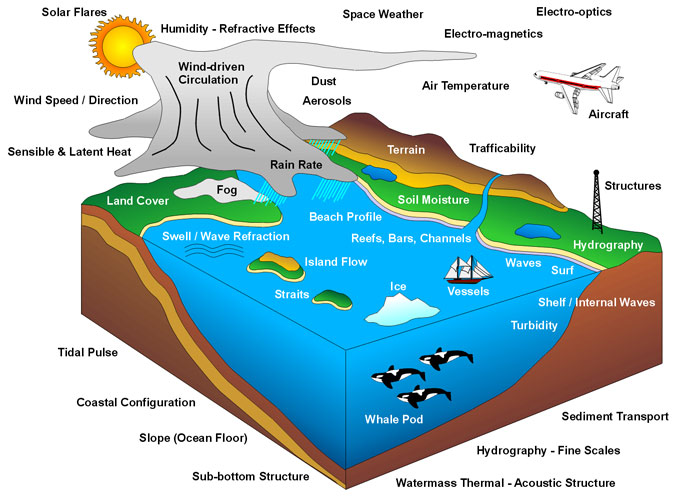
Figure -- Example environmental concepts
Return to: Top of this
Page
|