
Information technology
--
Computer graphics and image processing --
Environmental Data Coding Specification (EDCS)

The purpose of ISO/IEC 18025, the Environmental Data Coding
Specification (EDCS), is to insure that environmental concepts are unambiguously
defined; flexibly denoted and encoded; and easily bound in exchange formats and
to programming languages. These environmental concepts are:
- classifications that define the type of environmental objects,
- attributes that define the state of environmental objects, and
- enumerants and units that define how values of properties are characterized.
Classifications define the types of environmental objects
such as bridges, buildings, oceans, clouds, whale pods, trees and
automobiles.
Attributes define state (sometimes called properties) of
environmental objects such as size, colour, temperature, salinity, humidity and
frequency.
Enumerants define a finite set of possible values of properties such as {red,
orange, yellow, green, blue}. Units define a nomenclature for
characterizing specific quantitative values of properties such as length, area, thermodynamic temperature, pressure, and electric potential.
Denoting and encoding a concept requires a standard way of identifying the
concept by use of a label or code.
The scope of this International Standard includes but is not limited to:
- abstract concepts (azimuth angle, accuracy)
- airborne particulates and aerosols (fog, cloud, smoke)
- animals (humans, civilians, dogs, whales)
- atmosphere and atmospheric conditions (precipitation, temperature, pressure, wind speed and
direction)
- bathymetric physiography (reef, bar, channel, seamount)
- electromagnetic and acoustic phenomena (light, sound, vibration, x-rays)
- equipment (boat, plane, automobile, satellite, traffic light, furniture,
elevator)
- extraterrestrial phenomena (comet, planetary body, solar corona)
- hydrology (lake, ground water, rapids, geyser)
- ice (glacier, iceberg, icecap, ice field)
- man-made structures and their interiors (building, room, hallway, road, bridge, city)
- ocean and littoral surface phenomena (current, tide, swell, waves, surf)
- ocean floor (coral, sand, rock)
- oceanographic conditions (temperature, salinity, oyster bed, sound speed)
- physiography (valley, mountain, cliff)
- space (charged particle, magnetic field)
- surface materials (soil, concrete, painted wood)
- vegetation (crop, forest, kelp)
Figure 1.1 illustrates some concepts within the scope.
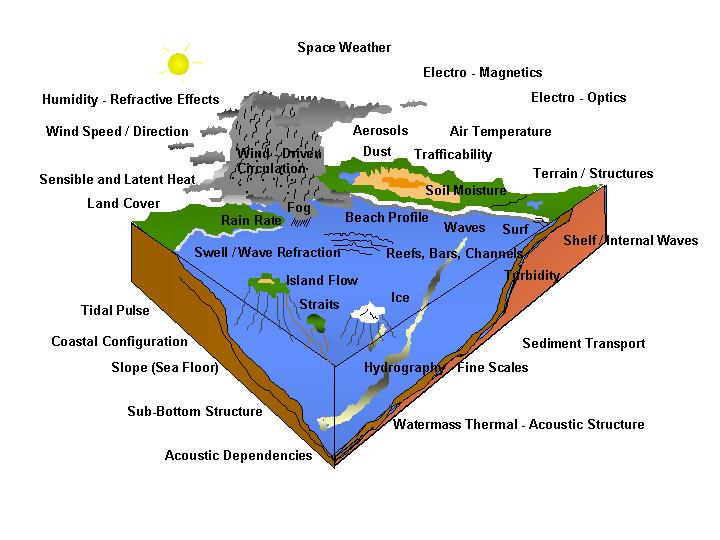
Figure 1.1 -- Example
environmental concepts
http://www.sedris.org/Specifications/EDCS/index.html