SEDRIS™ Technology Conference 2004
Plenary Session
.

The Plenary Session was a focal point where leading figures in the field shared their views regarding how the application of cutting-edge environmental technologies are shaping the future. Invited speakers, along with an update on the state of SEDRIS and other related technologies, rounded out the plenary session.

Photos by:_Chuck Weirauch (MS&T) and Tim Gifford (AFTS)


Conference Welcome
Farid Mamaghani
Conference Chair
SEDRIS
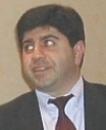
    Farid Mamaghani welcomed the attendees, and provided introductory and administrative remarks regarding several of the activities on the conference agenda. He concluded his remarks by introducing the first Plenary Session speaker, Colonel Michael Finnern, Director of the Defense Modeling and Simulation Office.
Excerpt:_ MP3_(45 Kb)_ |_ Text Version
.
Photo of Farid Mamaghani (SEDRIS)
.
Farid Mamaghani
SEDRIS
.

DMSO Welcome [no slides]
Michael Finnern, Colonel, U.S. Air Force
Director
Defense Modeling and Simulation Office (DMSO)
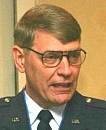
    Michael Finnern provided introductory remarks, briefly addressed the continuing DMSO support for SEDRIS and his commitment to the ongoing SEDRIS International Standardization efforts, expressed admiration for the partnership of the SEDRIS community, and encouraged technical input from the conference attendees.
Excerpt:_ MP3_(87 Kb)_ |_ Text Version
.
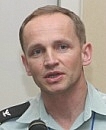
Photo of Michael Finnern (DMSO)
.
Michael Finnern
DMSO
.

State of SEDRIS
Farid Mamaghani
Conference Chair
SEDRIS
    Farid Mamaghani provided some historical background information, and discussed the key technical and business approach principles employed in the development of SEDRIS. He described where SEDRIS is today, and the growing team of national and international associate developers and implementers. Farid addressed how SEDRIS technologies solve environmental challenges, and provided the 2003 highlights in terms of software releases, meetings, training, tool releases, and ISO/IEC specification releases. He described the primary components of the SEDRIS SDK, and details of the SEDRIS reference implementation. Farid concluded his presentation with a discussion of the progress of the ISO/IEC standards development efforts, and where SEDRIS is headed.
Excerpt:_ MP3_(153 Kb)_ |_ Text Version
.
Photo of Farid Mamaghani (SEDRIS)
.
Farid Mamaghani
SEDRIS
.

USJFCOM / JWFC Leading DoD Training Transformation
Stephen Moore, SES 4
Director
Joint Training Analysis & Simulations Center (JTASC), U.S. Joint Forces Command (JFCOM)
    Stephen Moore briefly stated the Joint Warfighting Center's (JWFC) mission, discussing the joint/combined exercise support planned for Fiscal Years 2004 and 2005, and describing the exercise architecture and the Joint Operations Module. He then related what JWFC is up to this year by discussing JFCOM doctrine. Stephen addressed joint lessons learned over the past year, and discussed the need for a Joint National Training Capability (JNTC). He stated that the rapid accessibility of environmental databases is critical to the success of joint forces training -- one of the key JNTC challenges is to provide an interoperable, seamless environment that incorporates live, virtual and constructive elements, and although the standardization of environmental databases is a huge challenge, it is one that must be met to provide the interoperability that is essential for the success of the JNTC concept. He identified JNTC sites worldwide, and described an interconnected network of centers of excellence bridged through JFCOM and NATO. Stephen concluded his presentation by addressing JNTC technical challenges, highlights, and what lies ahead for environmental representation and modeling and simulation standards.
Excerpt:_ MP3_(105 Kb)_ |_ Text Version
.
Photo of Stephen Moore (JFCOM)
.
Stephen Moore
JFCOM

Simulation and Visualization at the National Institute of Standards and Technology
Charles McLean
Group Leader
Manufacturing Simulation and Modeling National Institute of Standards and Technology (NIST), U.S. Department of Commerce
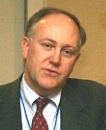
    Charles McLean provided a brief overview of NIST, and their subordinate Manufacturing Engineering Laboratory (MEL). He described the NIST 2010 Strategic Plan -- a new and comprehensive approach to envisioning NIST’s future. Charles stated that the U.S. economy depends on NIST measurements and, in particular, MEL develops and promotes measurements and standards for "making things". He addressed the goal of the MEL Simulation and Visualization Program, and provided some examples of their work, as well as modeling and simulation tools they employ. Charles explained how environmental data standards will provide major benefits for future U.S. Navy PC-based training programs that NIST is helping develop. He also pointed out that SEDRIS standards will prove useful in the development of commercial manufacturing simulations. He concluded his presentation by discussing the Simulation Standards Consortium -- a NIST-led consortium to address industry manufacturing simulation standards needs that is comprised of organizations from government, industry, software vendors, research institutions, and academia.
Excerpt:_ MP3_(28 Kb)_ |_ Text Version
.
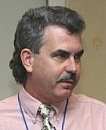
Photo of Charles McLean (NIST)
.
Charles McLean
NIST
.

The Army Geospatial Data Integrated Master Plan (AGDIMP)
George Stone, Colonel, U.S. Army
Deputy Director
Army Model and Simulation Office (AMSO)
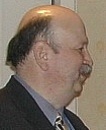
    George Stone provided background of the AGDIMP, and expressed that in today's environment, barriers exist in obtaining and using geospatial data. He then addressed the geospatial data challenge by discussing source information issues, data collection and fusion issues, application execution environment issues, and responsible organization issues, concluding that we need to have a complete end-to-end process. George then emphasized the growing dependency on geospatial intelligence -- the data that tells the troops just where they are at any given moment. The need has become more critical as the environments where conflicts may take place have changed from the traditional sites to "those where we are not planning to go to war." He stated that the largest problem is that there are no common standards for this data. George concluded his presentation with a discussion of filling this lack of geospatial intelligence by leveraging the successes of SEDRIS, and pointed out several ways the SEDRIS organization can help the Army fill the environmental data gap.
Excerpt:_ MP3_(73 Kb)_ |_ Text Version
.
Photo of George Stone (AMSO)
.
George Stone
AMSO

Future Combat Systems (FCS) Training
Rob Cox *
FCS Training Systems Integrated Product Team (IPT)
Science Applications International Corporation (SAIC)
    * James Shiflett (FCS Training Systems Director, SAIC) could not attend the conference, and his slides were presented by Rob Cox.
    Rob Cox discussed the concept of "embedded training" -- described as a DoD plan, an Army commitment, and a FCS requirement. He described the FCS training concept, training system capabilities, and the training requirements in the FCS Operational Requirements Document (ORD). Rob went on to address training products, training key performance parameters (KPP), critical enabling KPP requirements, and dependencies and constraints. He expanded upon the FCS ORD requirements, addressing the requirement for a common environmental representation, notional FCS environmental data flow, the FCS environmental data model, the data modeling process for environmental representation, the environment data dictionary, and tools. Rob stated that the number of environmental requirements for the FCS program is an order of magnitude larger than the requirements for its training component. This is, in part, driven by the FCS requirement for embedded training on program vehicles and equipment. He stated that FCS is migrating the concept of a natural operational environment to embedded training, in order to provide a computerized depiction of where the forces are located. Rob emphasized that the FCS program requires environmental data from all domains, including terrain, atmosphere, ocean and space data.
Excerpt:_ MP3_(128 Kb)_ |_ Text Version
.
Photo of Rob Cox (SAIC)
.
Rob Cox
SAIC
.

Return to: Top of this Page