The SEDRIS Data Representation Model
APPENDIX A - Classes
Property Description
|
|---|
Class Name: Property Description
Subclasses
This DRM class is concrete and has no subclasses.
Definition
Used to elaborate a property attribute of an
<Aggregate Geometry> or
<Aggregate Feature> instance and/or its
component inheritance subtree by attaching
<Property Characteristic> components
and/or qualifying (limiting) <Property Value>
components which meaningfully qualify the attribute identified by the
<Property Description>.
Primary Page in DRM Diagram:
Secondary Pages in DRM Diagram:
Example
- Consider a <
Union Of Primitive Geometry> containing <Polygons>,
each of which has an emissivity applicable to the IR band only, where valid
values are less than or equal to 1.0.
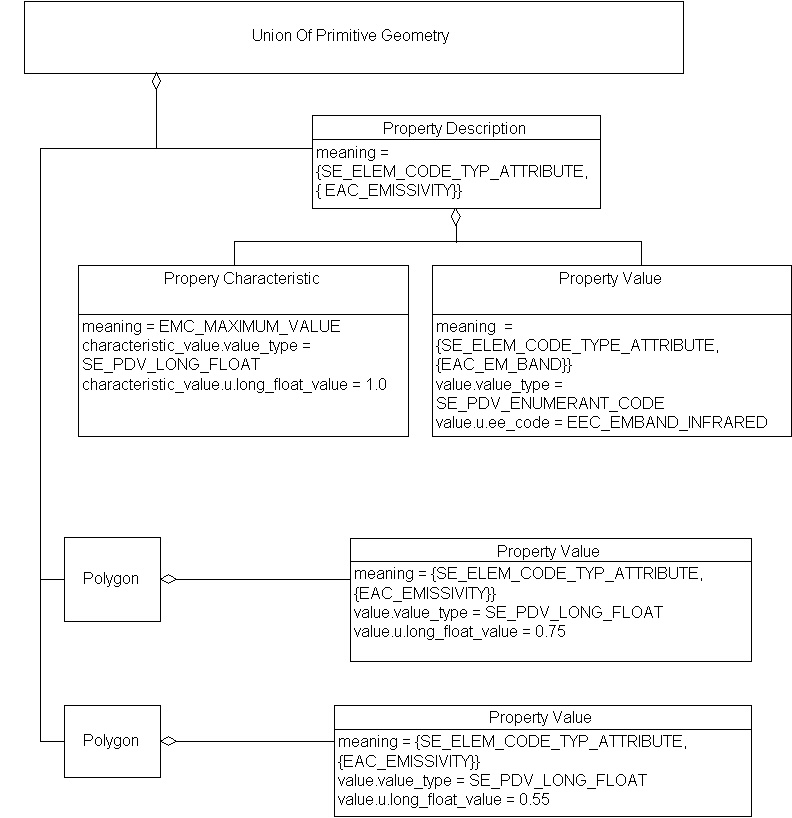
The emissivity of each <Polygon> is applicable to
the IR band only, because that property is so qualified by inheritance.
- Consider a <Union Of Features>
containing various <Primitive Features>
that shall specify dewpoint temperature. For all the
<Primitive Features> in this aggregate,
the dewpoint temperature given was taken at a height
of 10 metres above the surface of the terrain, and is of good quality.
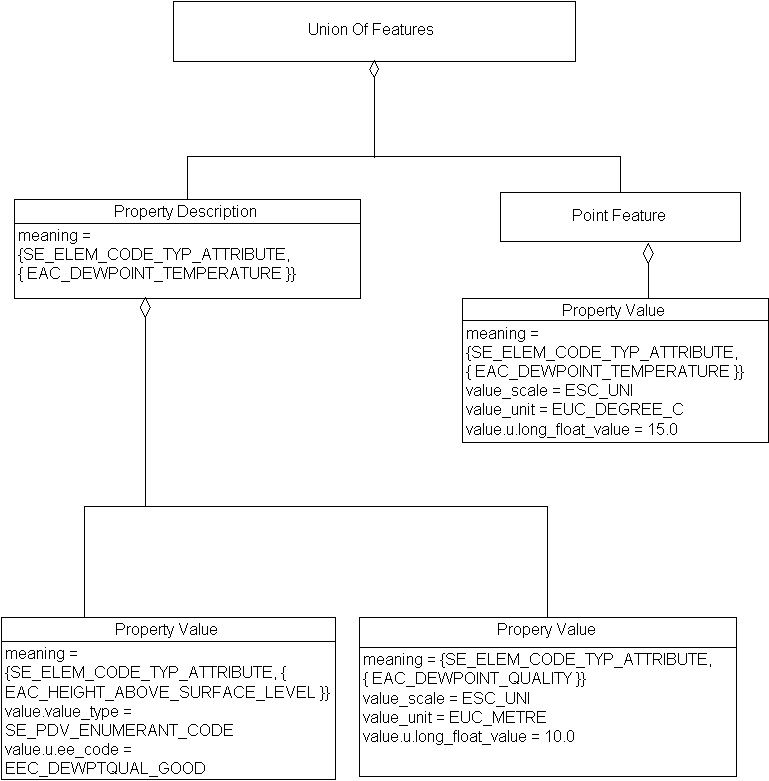
Since the <Point Feature>'s
<Property Value> describes
EAC_DEWPOINT_TEMPERATURE, it inherits
the following qualifiers:
- The dew point temperature measurement was taken at a height of 10 m
above the surface, and
- The measurement is of good quality.
FAQs
- How does an aggregate object use a <
Property Description>?
- In two ways, either separately or in combination.
- An aggregate may use a <
Property Description> to specify
<Property Characteristic> components
(such as maximum value for a quantity).
- An aggregate might also use a <
Property Description>'s <Property Value>
components to qualify an EAC.
All objects in the component inheritance tree of the aggregate, as long
as they have <Property Value> instances
with a matching EAC, are subject to the <
Property Descriptions> and / or qualifying values.
- Can a data provider qualify an attribute A with two sets of qualifying
<Property Value> instances, {b1, c1} and
{b2, c2} by associating two <Property Value>
instances for A with the corresponding qualifier set?
- No. This situation requires a <
Property Table>.
- Are there any restrictions on the <
Property Value> components?
- Only semantic restrictions. For example, it makes sense to limit
the applicability of an electromagnetic emissivity value to a
particular electromagnetic band. But it would be nonsensical
to limit an electromagnetic band to a particular emissivity value.
Constraints
Composed of (two-way)(inherited)
Composed of (two-way)
Component of (two-way)
Notes
Fields Notes
Specifies the meaning of the <Property>.
Specifies the unit of measurement of the <Property>.
Specifies the scale applicable to value_unit.
Prev: Property Characteristic.
Next: Property Grid.
Up:Index.
|
Last updated: October 1, 2002
|
Copyright © 2002 SEDRIS™
|
|