|
The SEDRIS Data Representation Model
APPENDIX B - Constraints No Attribute Conflicts |
|---|
No two directly attached <Property Value> components of an object instance may specify identical values for their meaning fields.
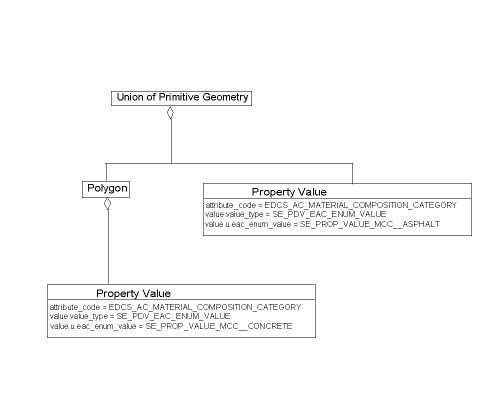
If an inherited <Property Value> has the same meaning field value as a directly attached < Property Value>, then the directly attached component replaces the inherited component in the inheritance context.
No two directly attached <Property Description> components of an object instance may specify identical values for their meaning fields.
If an inherited <Property Description> has the same meaning field value as a directly attached < Property Description>, then the directly attached component replaces the inherited component in the inheritance context.
The intent of this rule is eliminate ambiguity in specifying the attributes of an object instance.
The < Union Of Primitive Geometry> has a < Property Value> component with meaning = { SE_ELEM_CODE_TYP_ATTRIBUTE, {{ EAC_PRIMARY_MATERIAL_TYPE }} and its value is EEC_PRIATTY_ASPHALT. This is inherited by all the <Polygons> of the union, so that if a <Polygon> represents a section of asphalt, it need not specify any further information.
Consider a <Polygon> in the union which represents one of the areas of concrete. This <Polygon> has a < Property Value> component which also has meaning = { SE_ELEM_CODE_TYP_ATTRIBUTE, {{ EAC_PRIMARY_MATERIAL_TYPE }} but with value EEC_PRIATTY_CONCRETE. For that <Polygon>, the EEC_PRIATTY_CONCRETE value overrides the inherited EEC_PRIATTY_ASPHALT value.
The <Geometry Model>'s <Geometry> (and/or < Feature Model>'s <Feature Hierarchy>, as the case may be) is just a < Geometry Model Instance> (or < Feature Model Instance>) which instances the building component model in (1), above.
|