The SEDRIS Data Representation Model
APPENDIX A - Classes
State Related Features
|
|---|
Class Name: State Related Features
Subclasses
This DRM class is concrete and has no subclasses.
Definition
A mechanism for specifying discrete states from a possibly continuous
state value. Each discrete state corresponds to a branch of the
<State Related Features> and is
identified by the <State Data> for
that branch; the state value itself is given by the
state_tag
of <State Related Features>.
Primary Page in DRM Diagram:
Secondary Pages in DRM Diagram:
This class appears on only one page of the DRM class diagram.
Example
- Consider a <Feature Model> describing
a road in various states
of damage, e.g. after flooding. The road's topological connections
are different in various states of damage, due to bridges being
washed away and various road segments being blocked due to
fallen trees and the like.
Consequently, the <Feature Model>
consists of a State Related Features
instance, with state_tag =
EAC_GENERAL_DAMAGE_FRACTION
and active_state
= 0.0 % (since we will initially start with
an undamaged road, before flooding).
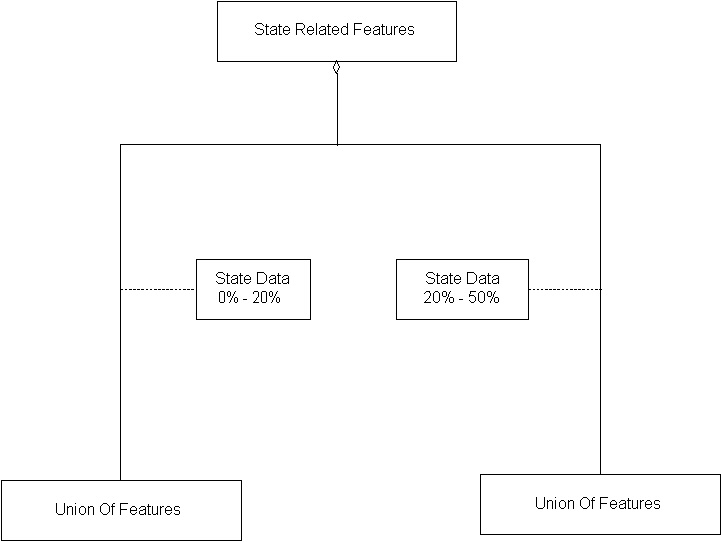
The <State Data> for each branch
indicates the range
of percent damage for which that branch describes the
road's feature topology.
FAQs
- Is <State Related Features>
the only way to represent multi-state objects in SEDRIS?
- No. <Control Links> can be used to
provide a fine level of control
over state by changing fields instead of representing states
as different <Features>.
Constraints
Associated by (one-way)(inherited)
Associated with (two-way)(inherited)
Composed of (two-way)(inherited)
Composed of (two-way)
Composed of (two-way metadata)(inherited)
Component of (two-way)(inherited)
Notes
Associated with Notes
 An association between two <Feature> instances indicates
 that they are alternate representations of the same
 environmental object.
 An association between a <Geometry Hierarchy> instance and a
 <Feature> instance indicates that the <Geometry Hierarchy>
 and the <Feature> are alternate representations of the same
 environmental object.
 An association between a <Property Grid> instance and a
 <Feature> indicates that the <Feature> and the <Property Grid>
 (or some specific cell data within that <Property Grid>) are
 alternate representations of the same environmental object.
 Each associated <Property Grid> will indicate which is the case.
Composed of Notes
 This relationship exists to support "attributes for derived objects."
 That is, these components are used only to specify texture mapping
 information for geometry that is to be derived from the
 <Aggregate Feature> by the consumer. These <Image Mapping Functions>
 shall use <Image Anchor> components to specify the mapping.
 This is needed because in many cases, an <Aggregate Feature> may be
 significant only for a particular domain, e.g. radar.
Fields Notes
 If this value is SE_TRUE, each 'descendant' of this aggregation -
 that is, each <Feature> object that exists in the component tree
 rooted at the given <Aggregate Feature> - shall be unique, in the
 sense that it shall appear in only one 'branch' of this aggregation.
 If unique_descendants is SE_FALSE, at least one <Feature> object
 appears in more than one 'branch' of the aggregation.
 If this value is SE_TRUE, each 'branch' of this aggregation
 strictly complies with the organizing principle for its
 particular subclass. If this value is SE_FALSE, at least
 one 'branch' does not strictly comply with the given
 organizing principle. See the organizing principle constraint
 for each specific subclass for details.
 The state by which the component <Feature Hierarchy> instances
 are being differentiated, which shall be an EAC which is designated
 as "state applicable".
 The default state.

 If a <State Control Link> is present, then this field
 is its target.
Prev: State Data.
Next: State Related Geometry.
Up:Index.
|
Last updated: October 1, 2002
|
Copyright © 2002 SEDRIS™
|
|