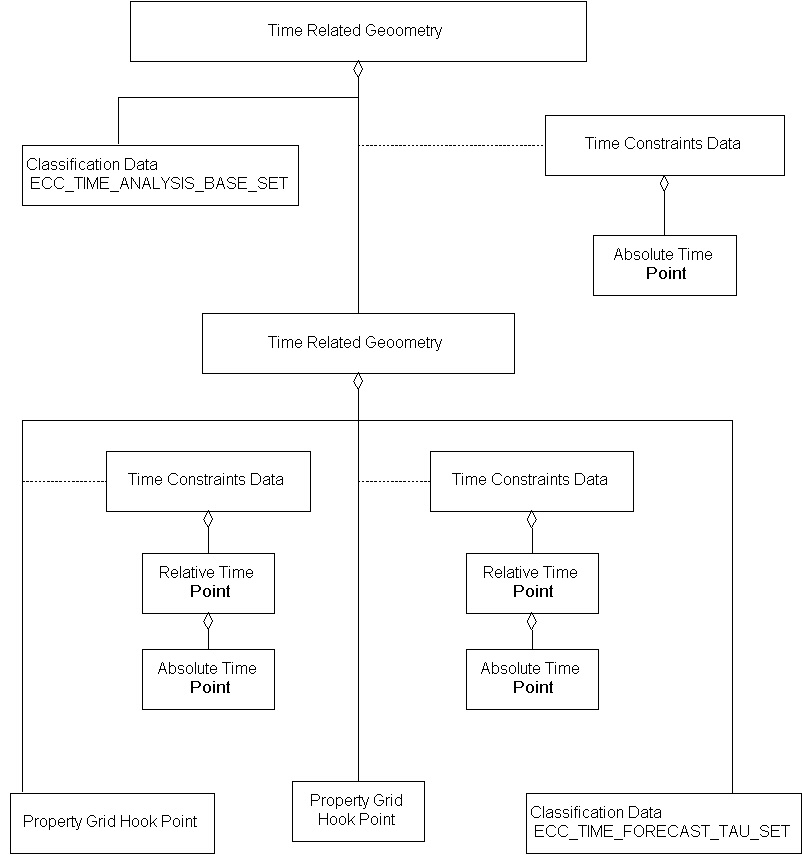
The <Classification Data> specify what each <Time Related Geometry> instance corresponds to. The outer < Time Related Geometry> corresponds to base forecast times, while the inner <Time Related Geometry> corresponds to forecast taus.
In the forecast world, models are run starting at some base starting time, e.g., at 0Z and 12Z. The model then produces forecasts at several deltas after the base starting time, e.g. at 6, 12 ,18, and 24 hours. These are known as forecast taus.
Consequently, if you run forecast models at 0Z and 12Z, and each produces a 24 hour forecast, you get the following overlap.
    16 Nov                 17 Nov                     18 Nov
    0Z   +6    +12   +18   +24
               12Z   +6   +12    +18    +24
                           0Z    +6     +12    +18    +24
                                  etc.
So to uniquely identify a forecast, the base forecast time and the delta (tau) are required. This is why nested <Time Related Geometry> has been used in this example; one < Time Related Geometry> defines the base forecast time, while its component <Time Related Geometry> defines the forecast tau.
Note that this approach is needed only if multiple forecasts with overlapping forecasts are included in the transmittal. If we just use the analysis (0Z) and +6 forecasts from each forecast, then we would have
    16 Nov             17 Nov
    0Z   +6  12Z  +6   0Z   +6   12Z   +6  etc
                <Model>
                  <>
                      |
            <Geometry Model>
                  <>
                      |
         <Time Related Geometry>
                      |
                      |---<Time Constraints Data>
                      |      <>
                      |         |
                      |   <Season>
                      |      time_significance =
                      |        SE_TIME_SIGNIFICANCE_CONTEXT_DETERMINED
                      |      season = SE_SEASON_AUTUMN
                      |      <>
                      |         |
                      |   <Relative Time Interval>
                      |
                      |
         <Union Of Primitive Geometry>